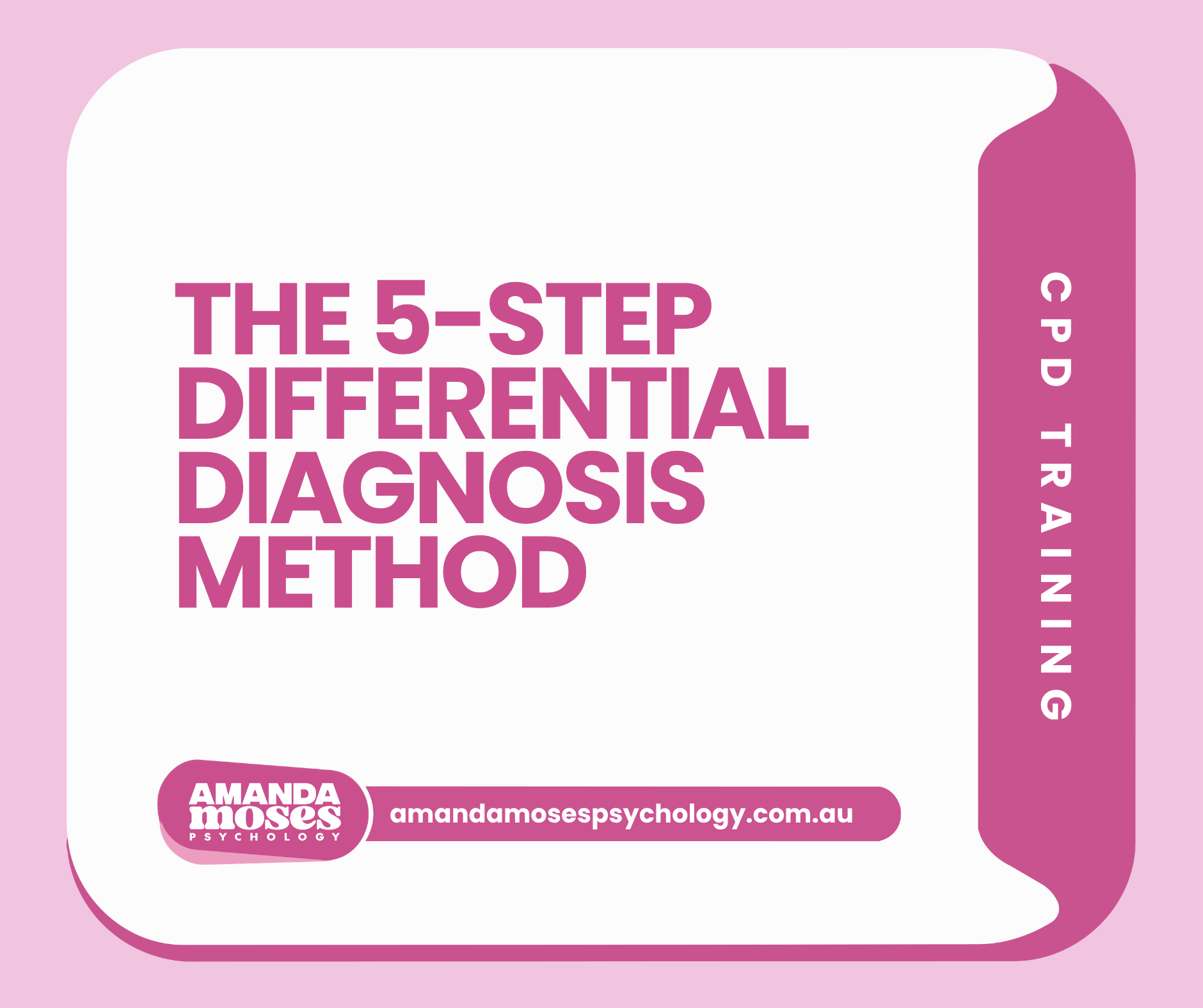
The 5-Step Differential Diagnosis Method
An evidence-based, stepped approach training in differential diagnosis for autism and ADHD assessments. Built specifically for complex cases.
- 3 Hours of Content
- 90 Days Access
- Certificate of Completion Included
- CPD/CE Elegible Course
- Neurodiversity-Affirming Approach
- Structured 5-Step Method
$200.00
Event Details
3 Hours of Content
Focused, evidence-based training
90 Days Access
From date of purchase

Certificate of Completion Included
CPD/CE Elegible Course
3 CPD/CE hours

Neurodiversity-Affirming Approach
Evidence-based clinical reasoning

Structured 5-Step Method
Practical diagnostic framework
About This Training
An evidence-informed approach to differential diagnosis for autism and ADHD assessments, built for complex cases.
Differential diagnosis is often taught as a checklist exercise, and real clinical complexity rarely works that way. This training introduces Amanda’s own 5-step method, developed for situations of genuine diagnostic complexity, where several explanations are plausible and autism and ADHD are hard to separate from other presentations.
You’ll work through the method step by step with a fictional complex case, using a detailed workbook and hypothesis board to test each explanation alongside Amanda. You’ll finish with a clear, repeatable framework you can apply directly to your next complex case.
This training was the first session in the Advanced Diagnostic Practice Series. The series has five trainings, each exploring a different part of assessment and diagnosis with a focus on complex presentations. Each training stands alone, so there’s no need to complete them in order or to do them all.
The next session, Evidence-informed Assessments: Qualitative, runs live on Friday February 12 2027, and tickets are on sale now.
Join the waitlist to be first to know when tickets are available for the other sessions in this series.
Learning Objectives
By the end of this training, you’ll be able to:
- Explain what differential diagnosis is and why it matters in complex presentations
- Describe the universal differential diagnosis method used across the DSM, and identify why it doesn’t always work in complex assessments or with autism & ADHD
- Apply Amanda’s 5-step method to cases with multiple plausible explanations, including autism and ADHD presentations that are hard to tease apart from other conditions
- Hold several plausible diagnostic explanations open and weigh them against each other as new evidence emerges
- Reason through whether more than one diagnosis is needed to explain a presentation, and when a trait or contributing factor is better captured in the formulation
- Apply the framework to your own complex cases with greater clarity and confidence
Who Is This Training For?
This training is suitable for psychologists and allied health professionals who want to strengthen their assessment and diagnostic skills, particularly those with some foundational knowledge of autism and ADHD diagnostic assessment.
Differential diagnosis is an advanced skill that foundational training often only touches on, and this training is built to fill that gap. It’s relevant whether you’re new to differential diagnosis and want a solid, repeatable framework, or you’ve done foundational training and want to apply it to real case complexity.
Worth noting: this method was first introduced in Amanda’s Differential Diagnosis: A Spotlight on Neurodivergence training, which covers differential diagnosis across a broader range of presentations, including complex trauma, intellectual disability, attachment disorders and personality disorders.
If you’ve completed that training, this one goes further. It’s dedicated entirely to the 5-step method, with a detailed worked case and practical strategies for using it in your own practice. If you haven’t, the Spotlight training is a great starting point, but you don’t need it to get value from this one.
Format and Access
Format and access
- Format: On-demand recorded training, with a downloadable workbook, plus the slides.
- Time commitment: About 45 minutes of workbook pre-reading and reasoning before you start, then the recorded training.
- CPD/CE hours: 3 CPD/CE hours, covering the recorded training and the pre-reading activities. You’ll receive a certificate once you’ve completed the training.
- Access period: 90 days from the date of purchase.
Terms and Conditions
Refund Policy: All sales are final.
Individual Use Only: This training is licensed for individual professional use. Unauthorised sharing or distribution of materials is prohibited.
By enrolling, you agree to the terms of purchase. Please review the full terms of purchase here: Terms of Purchase
Frequently Purchased With
Differential Diagnosis: A Spotlight on Neurodivergence
A structured, evidence-based training designed to strengthen clinical reasoning...
$250.00
Enrol Now
Autism & ADHD Diagnostic Assessment Training
Autism and ADHD Assessment Training provides a structured, evidence-informed fra...
$1,195.00
Enrol Now
Autism Diagnostic Report Writing Guide & Template
A complete, neurodiversity-affirming framework for writing clear, accurate, and ...
$100.00
Add to cart
ADHD Diagnostic Intake Questionnaire
This bundle features a set of in-depth qualitative intake questionnaires develop...
$150.00
Add to cart
ADHD Diagnostic Report Writing Guide & Template
A complete, neurodiversity-affirming framework for writing clear, accurate, and ...
$100.00
Add to cart
Autism Diagnostic Intake Questionnaire
A comprehensive, neurodiversity-affirming intake tool to support and streamline ...
$150.00
Add to cartTrusted by Thousands of Psychologists Worldwide
Amanda Moses has trained thousands of psychologists and allied health professionals internationally. Below is a selection of feedback from psychologists who have completed CPD training and courses through Amanda Moses Psychology.

The training has been invaluable - I am most grateful to you and your wisdom.
I am really enjoying your course so far- it's the most engaging CPD I have done for ages!!
I began my journey with Amanda's course on differential diagnosis, which I found to be exceptionally insightful. Driven by a desire to enhance my skills and a keen interest in ADHD and Autism, I enrolled in the ADHD and Autism assessment training. This training has provided me with a wealth of additional knowledge that I previously lacked. Having reviewed the training materials twice, I now feel confident in my ability to conduct assessments independently.
Amanda's passion for this field is evident in the extensive content she has developed, which has greatly facilitated my learning and effectiveness in this area. I am grateful to Amanda for her dedication and for making the learning process more accessible.
Thank you, Amanda, for your invaluable contributions.
I just wanted to say how much I enjoyed your adult autism and ADHD assessment training. It has been enormously helpful. Thank you!
I have always found Amanda’s trainings to be exceptionally well-paced, evidence-based, detailed, and practical. The content is thoughtfully delivered and provides clear strategies that can be readily applied in practice. Amanda is highly knowledgeable, and her trainings are well worth the investment. As a psychologist supporting Autistic and ADHD individuals across the lifespan, I would highly recommend any of her programs.
Your training is incredible!! I want you to know. It covers everything I could possibly want to know, from basic to all the extra considerations and complexities. I am truly loving it, applying it already in sessions with clients, and am shortly about to commence formal assessment. Thank you so much for this PD. I’m excited to engage in the last parts.
I just completed your program: Adult Autism and ADHD Diagnostic Assessment Training. It was excellent! Unbelievably comprehensive, structured very well and super easy to follow. I now feel confident in my understanding of Autism and ADHD, and feel lucky to have gained such wisdom about masking/internalised presentations. I truly wish I had this learning during university and am so grateful I chose your program to gain this learning. I will be recommending your training to anyone that is interested in this space
I’m doing the online, on demand version currently (of the autism and ADHD assessment training) and learning so much. Thoroughly impressed with this training!
I have worked for over 20+ years, and my trauma PD from 2008 onwards with leaders in the field was life changing for my practice.
Your training is incredible! I want you to know. It covers everything I could possibly want to know, from basic to all the extra considerations and complexities. I am truly loving it, applying it already in sessions with clients, and am shortly about to commence formal assessment. Thank you so much for this PD. I’m excited to engage in the last parts.
Thank you again
Since returning to work as a psychologist after extended maternity leave to care for my young family, I’ve embarked on a journey and a personal mission to learn as much as I can about neurodiversity affirming practice. It was amazing finding Amanda Moses’ work because I knew I could rely on the information she was providing to be truly NDA, which is something I often worried about earlier on in my journey. I recommend Amanda Moses Psychology to colleagues who endeavor to learn more about NDA practice, and I’m really excited to access further training through Amanda Moses Psychology.
Amanda's courses are definitely on my list for continuing PD - she's absolutely brilliant!
And super lovely - an incredible, empathetic and caring role model for sure x
Something else that has absolutely spurred me on - realising just how much Amanda is doing for Neurodiversity and those of us realising, we are ND a little later in life.
Having Amanda and a few others with similar passions providing so much support and education and acceptance has truly blown me away.
Amanda, your course and the way you present it, is truly at another level. I really don’t know how I would have managed without it. It was worth every cent!
Frequently Asked Questions
Do I need prior training in differential diagnosis or autism/ADHD assessment to attend?
No. This session stands alone and doesn't require any prior training in differential diagnosis. To make the most of this training, it's assumed you're either developing your skills in, or actively providing, diagnostic assessments in your work. Even if you don't provide autism and ADHD assessments specifically, but want help understanding how to tease them apart from complex presentations, this session will still benefit you.
If you are looking for a training to get you started in differential diagnosis, and one that would complement this webinar well, I recommend Differential Diagnosis: A Spotlight on Neurodivergence
If this is part of a series, will I need to attend others in order to get benefit?
This is the first session in the Advanced Diagnostic Practice Series, a set of six planned sessions over the coming year. Each session is completely standalone, so there's no need to attend in order, or attend more than one. These have been designed as complete trainings in their own right, while all forming part of the broader advanced diagnostic practice skill set.
How will I find out about future sessions in the series?
Future sessions will be announced separately as they're ready. Join the waitlist here to be notified as soon as a new session opens for registration.
Will this be different from what you taught in the Differential Diagnosis: A Spotlight on Neurodivergence training?
I first taught my 5-step method inside the Differential Diagnosis: A Spotlight on Neurodivergence CPD training. The method and framework will be the same, but this webinar spends the full session on the method itself, going further with practical strategies for implementing it in your own practice, something the original training didn't have time to cover in depth. There will also be case examples and demonstrations of how to apply this method in your clinical work that weren't included in that earlier training.
You don't need to have done that training to benefit from this webinar, and if you have, there will still be enough new content to benefit from having done both.
Will this cover differential diagnosis with presentations like PTSD, personality disorders, OCD, intellectual disability, etc?
This session teaches the framework itself, the stepped method Amanda uses to approach any differential diagnosis where autism and ADHD are part of the picture. Rather than working through specific co-occurring conditions one by one, you'll learn a method you can apply universally, whenever autism or ADHD is being considered alongside something else.
If you're looking for a training that focuses specifically on distinguishing autism from a particular presentation, such as OCD, PTSD, personality disorders, or intellectual disability, this is covered in depth in Amanda's Differential Diagnosis: A Spotlight on Neurodivergence training.
Are these CPD trainings suitable for psychologists in Australia and internationally?
Yes. All CPD trainings are highly relevant to psychologists practising in Australia. They are also widely used by psychologists and allied health professionals practising internationally. The clinical principles, assessment frameworks, and therapeutic approaches covered are broadly applicable across different practice contexts, and Amanda Moses Psychology has supported professionals across the globe.
Are your CPD trainings self-paced?
Yes. All CPD trainings are fully self-paced and available online, allowing you to complete them in a way that fits around clinical work and other commitments.
Amanda also runs live events and webinars a few times each year. You can view upcoming live training opportunities on the Upcoming Events page.
Can I complete these CPD trainings if I am a provisional psychologist?
Yes. Many CPD trainings are suitable for provisional psychologists, and some are specifically designed for this stage of practice, including National Psychology Exam preparation. Training levels are provided to guide your selection.
Can I rewatch the CPD training videos?
Yes. During your access period, you can rewatch and revisit training videos as many times as you like.
Are Amanda Moses Psychology’s trainings CPD-accredited?
Yes. All Amanda Moses Psychology trainings are developed as CPD (also referred to as CE in some international contexts) programs, and include certificates of completion outlining the course topic and learning hours for your records.
As with all professional development activities, how these hours are recorded and recognised depends on your professional body, regulatory requirements, and individual learning plan.
How do I access my CPD trainings?
Once enrolled, you can access your CPD trainings through your online account. Trainings can be viewed on desktop, tablet, or mobile devices.
Do you offer payment plans?
Flexible payment options are available through third-party providers such as AfterPay, and PayPal (where available).
Please note that these arrangements are between you and the payment provider. Access to the course is provided immediately upon purchase.
Contact Amanda Moses Psychology
I provide a range of services to support psychologists at every stage of their career.
Get In Touch
Have a question that isn’t answered on my site? Drop us a message below. We aim to respond within 5 business days.