When I first started exploring Neurodiversity Affirming Practice, it genuinely changed how I saw my role as a psychologist. Like many of you, my initial training was grounded deeply in the medical model—framing autism, ADHD, and other neurotypes primarily as disorders needing treatment. But as I grew in both my professional practice and personal experiences, I realised this perspective simply didn’t align with the lived reality of my neurodivergent clients, nor with the current research.
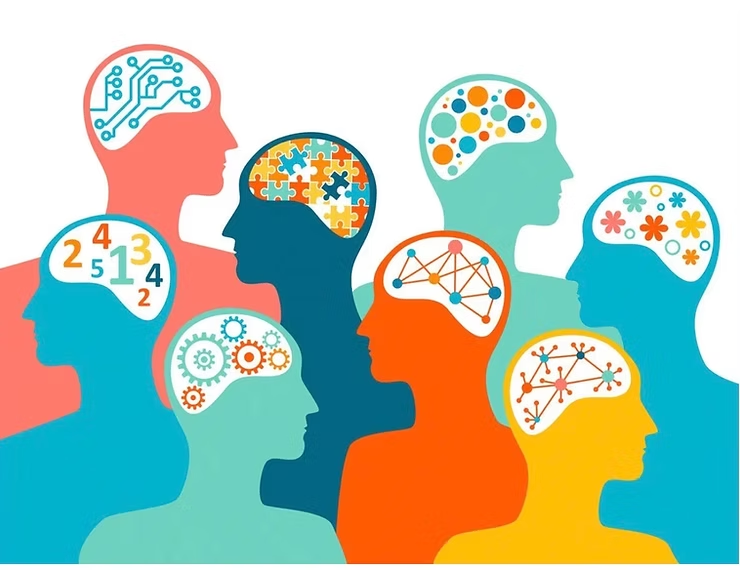
At its core, neurodiversity affirming practice moves away from seeing neurological differences like autism and ADHD as disorders to be fixed, and instead recognises them as natural variations of human cognition and behaviour.
Let me clarify this right away: I’m definitely not suggesting psychologists should be ignoring genuine struggles. Neurodiversity Affirming Practice simply acknowledges neurological differences as natural human variations, recognising that much of the distress neurodivergent individuals experience is rooted in societal barriers rather than their inherent neurotype.
Why Our Previous Approaches Have Often Caused Harm
Historically, psychology and mental health practice have focused heavily on “correcting” or “fixing” neurodivergent traits. While usually well-intentioned, these traditional approaches have often led neurodivergent people to internalise deeply harmful beliefs, including:
- Feeling inherently flawed or broken simply because their brains function differently.
- Experiencing profound internalised shame around their natural behaviours (such as stimming or sensory sensitivities).
- Developing mental health challenges such as anxiety, depression, or burnout due to relentless pressure to mask their authentic selves.
Ultimately, these approaches unintentionally teach clients that their worth depends on how convincingly they mask their differences, rather than how authentically they live. It’s important to acknowledge that autism and ADHD are neurotypes, not diseases that can be “cured.” Decades of clinical efforts aimed at doing exactly that have resulted in profound harm rather than relief or improvement.
What Neurodiversity Affirming Practice Is (and Isn’t)
Neurodiversity Affirming Practice deliberately shifts away from harmful narratives that frame neurodivergence as something inherently flawed or pathological. It doesn’t ignore the genuine difficulties people face, it just frames those difficulties differently.
Autism and ADHD are disabilities, and disability is a neutral word. While disability implies a limitation that requires supports and accomodations, the word ‘disorder’ implies that it is a pathological disease that needs curing. This small shift in language has huge impacts on the way people frame these neurotypes. Challenges for Autistic and ADHD’ers are compounded when their disabilities are not accommodated or acknowledged by the broader environments they are living in.
Put simply neurodiversity affirming practice:
- IS about adapting environments, offering reasonable accommodations and supports, and empowering clients to understand and embrace their differences
- It IS NOT about making clients appear neurotypical, pressuring them to suppress their differences for others’ comfort, or denying that being neurodivergent comes with challenges
Affirming practice challenges us as clinicians to shift our fundamental question from: “How can we change this person to better fit the environment?” to: “How can we change the environment to better support this person?”
Why Neurodiversity Affirming Practice Matters in My Work (and Yours)
As a neurodivergent psychologist, I’ve personally felt the weight of deficit-based assumptions. I know how exhausting it is to be perceived as inherently deficient, broken, or inadequate just because I navigate the world differently.
Adopting a neurodiversity affirming practice is essential for ethical practice. It actively reduces harm by decreasing internalised shame that many neurodivergent people face after internalising that there is something inherently ‘wrong’ with them. It creates spaces where neurodivergent people can be authentically themselves, rather than trying tirelessly to be something they are fundamentally not.
Practical First Steps for Your Practice
Simple shifts in your therapeutic practice can profoundly impact your neurodivergent clients’ well-being. It is about being intentional with your work:
- Proactively accommodate sensory needs: Offer noise-cancelling headphones, dim lights, or comfortable seating options.
- Use clear, direct communication: Autistic people often rely on explicit, literal communication rather than ambiguity.
- Honour routines and transitions: Provide advance notice about changes to reduce anxiety.
- Support natural self-regulation strategies: Encourage stimming, pacing, or the use of sensory tools.
- Collaboratively set affirming therapy goals: Aim for increased autonomy, meaningful self-expression, and authentic living—not behavioural conformity.
When working with neurodivergent clients, it’s important to evaluate the intent behind therapy goals:
- Who benefits from this goal—the neurodivergent person, their family, or society?
- Does this goal support the client’s well-being, autonomy, and self-acceptance?
Neurodiversity Affirming therapy does not aim to “fix” neurodivergent behaviours simply because they don’t align with neurotypical norms. Instead, it supports clients in navigating their world authentically and effectively.
Addressing Bias in Psychological Practice
Many psychologists carry unexamined biases from our clinical training or cultural assumptions. These might include:
- Expecting eye contact as proof of engagement.
- Viewing stimming as disruptive.
- Interpreting social non-conformity as problematic behaviour.
- Over-valuing verbal communication and dismissing alternative methods (AAC).
Regularly reflecting on these biases is important to becoming genuinely affirming clinicians. Being an affirming psychologist requires self-reflection, education, and advocacy. Ask yourself:
- Am I using affirmative language when discussing neurodivergence?
- Am I centring the neurodivergent person’s voice rather than external expectations?
- Am I challenging outdated clinical narratives about autism and ADHD?
Applying Neurodiversity-Affirming Practice to Assessment
Neurodiversity-affirming practice is especially important in diagnostic assessment, where traditional models have often failed individuals with internalised, masked, or non-stereotypical presentations. An affirming approach to assessment prioritises clinical reasoning, lived experience, developmental context, and ethical decision-making over rigid checklists or surface-level observations.
- For a deeper look at qualitative, strength-based autism assessment, see how the MIGDAS supports neurodiversity-affirming assessment.
- To explore the limits of structured tools and why clinical context matters, read the role of structured clinical interviews in autism assessment.
- For guidance on differential diagnosis and avoiding misidentification, explore how to differentiate between ADHD and autism in clinical assessment.
The Bigger Picture—Why Neurodiversity Affirming Practice is Essential
Neurodiversity affirming practice isn’t just another therapeutic approach, it’s an ethical imperative. It actively repairs harm done by outdated deficit-based approaches and creates spaces where neurodivergent people genuinely thrive.
If you’re ready to bring these affirming principles fully into your clinical practice, I’ve developed practical resources and trainings specifically for psychologists like you.